The Secret Grandma Kept for More Than Twenty Years
We thought it would be an ordinary family celebration.
Everyone had dressed up for the occasion, the weather was beautiful, and for once, nearly the whole family had managed to be in the same place at the same time. Before dinner, we gathered outside to take a few photographs.
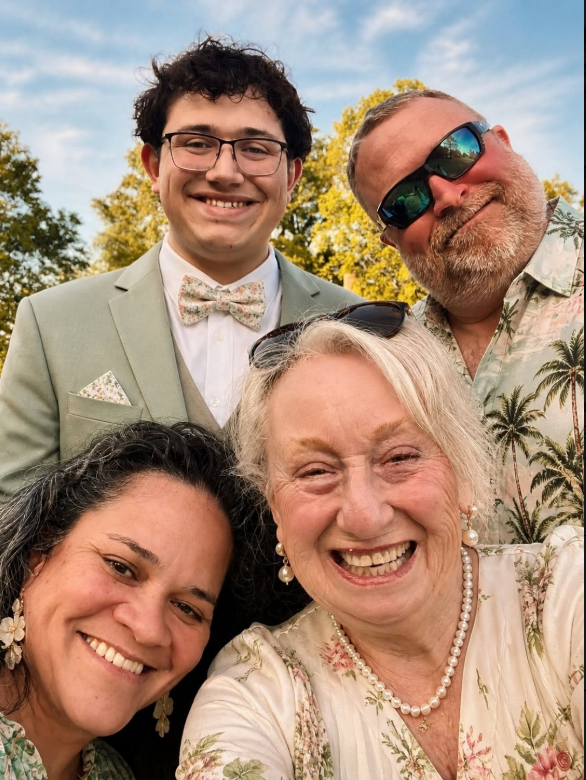
Grandma stood at the front, wearing her favorite pearl necklace and a floral dress she had carefully chosen days earlier. She was smiling so widely that nobody could look at her without smiling too.
Dad stood behind her, joking as usual. My brother adjusted his bow tie while the rest of us tried to fit into the frame.
At that moment, the photograph seemed like nothing more than a happy family memory.
None of us realized that Grandma was carrying a secret she had kept for more than twenty years.
“Please Don’t Go Inside Yet”
After the photo was taken, everyone began walking toward the dining room. Grandma stayed where she was.
“Please don’t go inside yet,” she said.
Her voice was gentle, but there was something serious in it that made us stop.
She reached into her handbag and pulled out a small envelope. It was old and slightly yellow around the edges. A name had been written across the front in faded blue ink.
It was Dad’s name.
At first, he smiled and asked whether she had brought him an early birthday card. Grandma did not laugh.
Instead, she held the envelope against her chest and took a slow breath.
“I should have given this to you a long time ago,” she said. “But I was afraid.”
The cheerful noise around us disappeared. Even the children seemed to sense that something important was happening.
Dad stepped closer and accepted the envelope with both hands.
A Letter Written During the Hardest Year of Their Lives
The letter had been written more than two decades earlier, during a period our family rarely discussed.
At that time, Dad was struggling to keep his small business alive. Bills were arriving faster than he could pay them, and he often worked late into the night. He and Mom had young children to support, but they never allowed us to see how frightened they were.
We remembered the lights being switched off in rooms nobody was using. We remembered simple dinners, secondhand clothes and family trips quietly disappearing from the calendar.
As children, we thought our parents were merely being careful with money.
We did not know how close they had come to losing everything.
Dad unfolded the letter, but his hands were trembling too much to hold it steady. Grandma gently took it back and asked whether she could read it aloud.
He nodded.
The letter had been written by Grandpa shortly before he died.
Grandpa had been a quiet man. He loved his family deeply, but he was not someone who spoke openly about his feelings. Dad had always believed that Grandpa was disappointed in him, especially during those difficult years.
The letter revealed something very different.
The Words Dad Had Waited a Lifetime to Hear
Grandma began reading.
Grandpa wrote that he knew Dad was struggling, even though Dad had tried to hide it. He wrote that watching his son work so hard had filled him with both worry and pride.
He admitted that he had never been good at expressing love.
He also admitted that his silence may have made Dad believe he was being judged.
Then came the words that changed everything:
“You may think I see your struggles as failure, but I see a man refusing to abandon his family. I have never been more proud to call you my son.”
Dad lowered his head.
For most of my life, I had seen him as the person who remained calm when everyone else was frightened. He fixed problems, supported relatives and rarely allowed himself to show pain.
But as Grandma continued reading, tears began falling onto his shirt.
Mom covered her mouth and started to cry too.
None of us had ever heard Grandpa speak that way when he was alive. Dad certainly had not.
For more than twenty years, he had carried the belief that he had disappointed his father. The truth had been sitting inside an envelope all along.
Why Grandma Hid the Letter
When Grandma finished the first page, she stopped.
Dad looked at her and asked the question everyone was thinking.
“Why didn’t you give it to me?”
Grandma’s eyes filled with tears.
She explained that Grandpa had written the letter during his final illness. He had asked her to give it to Dad when the family’s financial troubles were over.
But after Grandpa passed away, everything became overwhelming. Grandma was grieving, Dad was trying to keep the family together, and the letter was placed inside a box with other personal belongings.
Months turned into years.
By the time Grandma found it again, Dad’s business had recovered. Life had moved forward. She worried that giving him the letter would reopen old wounds.
So she waited.
Every year, she told herself she would find the right moment. Every year, fear stopped her.
“I thought I was protecting you,” she told Dad. “But I understand now that I was protecting myself from seeing your pain.”
Dad did not respond immediately.
Then he walked forward and wrapped his arms around her.
“You should have given it to me,” he whispered. “But I’m glad you gave it to me today.”
The Final Sentence
We believed the emotional part of the letter was over.
Then Grandma turned the page.
“There is one more sentence,” she said.
Her voice broke as she read it.
“If I am not there when this family gathers again in happier times, tell them that everything I worked for was never meant to be measured in money—it was meant to be seen in the way they continue loving one another.”
Nobody spoke.
We looked at each other, then at the photograph we had taken only minutes earlier.
There we were: several generations standing together, smiling beneath an open sky.
Grandpa was not physically present, but in that moment, it felt as though the final sentence had been written for that exact day.
The struggles he had witnessed were over. The children had grown. The family had survived arguments, illness, financial hardship and painful goodbyes.
Yet somehow, we were still together.
A Photograph That Now Means Something Different
After Grandma finished reading, we did not immediately return to dinner.
We remained outside, holding one another and sharing memories about Grandpa. Some were funny. Others brought tears.
Dad admitted that he had spent years wondering whether his father respected the man he had become.
That letter finally gave him an answer.
Grandma apologized again for waiting so long. Dad told her that regret would not change the past, but honesty could change what happened next.
He asked her not to hide difficult feelings from the family anymore.
She promised she would not.
Before going inside, we took one more photograph. This time, nobody worried about standing perfectly or looking directly at the camera.
It was not as polished as the first picture, but it was more honest.
Grandma was crying and smiling at the same time. Dad had one arm around her. The rest of us stood close together, understanding that we had just witnessed something we would never forget.
Say the Important Words While There Is Still Time
That evening taught us a lesson bigger than the secret itself.
Families often believe there will always be more time.
More time to explain.
More time to apologize.
More time to say, “I am proud of you,” “I forgive you,” or “I love you.”
But important words should not remain hidden inside drawers, boxes or unopened envelopes.
Grandpa’s letter brought comfort, but it also reminded us of the conversations that never happened while he was alive.
Since that day, our family has tried to speak more openly. We still disagree. We still make mistakes. But we no longer assume that the people we love already know what is in our hearts.
Sometimes, one honest sentence can heal a wound that has existed for decades.
And sometimes, an ordinary family photograph becomes proof that love survived everything.

