The Old Photograph That Reminds Me How Much Life Has Changed
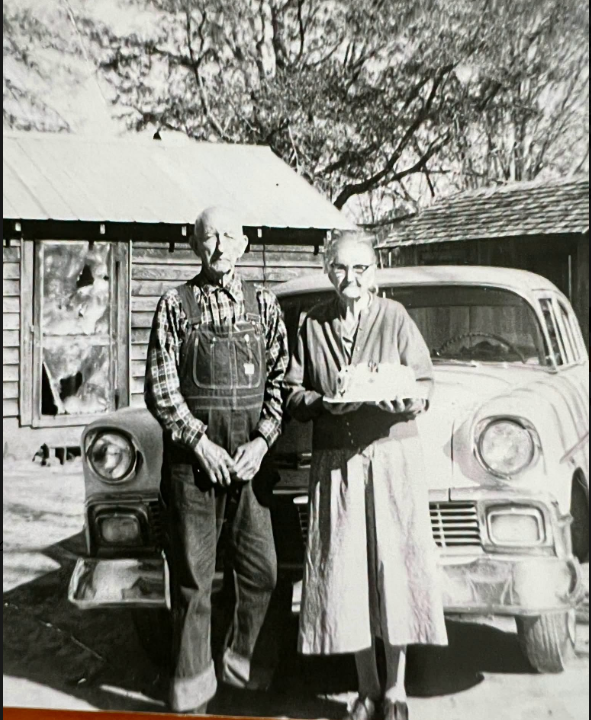
Every time I look at this old photograph, I find myself staring a little longer than I intended.
These are my husband’s grandparents, standing outside their home beside their car. Mary Adaline is holding a cake in her hands, and judging by the way they are dressed in their Sunday best, I like to imagine they were getting ready to go somewhere special—perhaps a church gathering, a birthday, or a family celebration.
We may never know exactly where they were going that day.
But what touches me most isn’t the destination. It’s the life that existed behind this photograph.
A Life That Was Simple, but Never Easy
Their world was very different from ours.
They had a garden and raised farm animals. Much of what appeared on their dinner table came from their own land and their own hard work. There weren’t supermarkets full of ready-made meals or conveniences waiting around every corner.
George once told me something about his grandmother Mary Adaline that I have never forgotten.
When hog-killing time came around, she wanted enough lard put away to last the entire year.
Her goal was 52 gallons—one gallon for every week of the year.
That number might sound unbelievable today, but lard was an essential part of her kitchen.
She used it for biscuits and pie crusts, fried pies, cakes and cookies. She fried chicken and pork chops in it and used it when making gravy.
There was often a big black skillet sitting on the stove, ready for the next meal.
Nothing was wasted.
Everything had a purpose.
There Was Always Something on Mary Adaline’s Table
George remembered something else about his grandmother’s kitchen.
On her table, you could almost always find a cold biscuit, a piece of crunchy cornbread, or a baked sweet potato.
She would place the food in the middle of the table and cover it with a flour sack to keep the flies away.
Leftovers went there too.
It wasn’t fancy, but there was something beautiful about it: if somebody walked through the door hungry, they could eat.
They didn’t need an invitation.
They didn’t need an appointment.
If there was food on the table, there was food to share.
And sometimes the people who came through that door weren’t family at all.
Even Strangers Knew Where to Find a Meal
Their home stood near the railroad tracks.
Back then, men traveling from place to place sometimes rode in freight cars. George said some of them would jump off the trains and make their way to Mary Adaline’s house looking for something to eat.
Apparently, word had traveled among them.
They knew about the woman near the railroad tracks who wouldn’t turn away a hungry person.
And Mary Adaline fed them.
I often wonder how many strangers sat near that little house over the years. How many hungry men received a plate of food, thanked her, and then disappeared down the railroad tracks, never to be seen again?
She probably never knew what became of most of them.
But for one meal, they weren’t strangers.
They were simply hungry people sitting at a table where there was enough to share.
Maybe That’s Why This Photograph Means So Much
When I look at this picture today, I see more than an elderly couple standing beside an old car.
I see a generation whose lives were built around hard work, faith, family, resourcefulness and hospitality.
They didn’t have everything.
But what they had, they shared.
Life wasn’t necessarily easier back then. Farm work was demanding, money could be scarce, and there were few of the conveniences we take for granted today.
Yet sometimes I wonder whether they possessed something we’ve slowly lost.
People seemed to have more time for one another.
A kitchen table wasn’t only where a family ate—it could become a place where a neighbor, relative or complete stranger knew they would be welcomed.
I Wish My Grandchildren Could Have Known Them
Thinking about Mary Adaline brings back memories of my own granny and Big Daddy.
They belonged to that same kind of generation—hard-working, God-fearing, church-going people who understood that love wasn’t always expressed through words.
Sometimes love was a hot meal.
Sometimes it was a biscuit waiting on the table.
Sometimes it was opening your door to someone who had nowhere else to go.
I wish my grandchildren could have known people like them and experienced that kind of life for themselves.
We can’t turn back the clock, and perhaps we wouldn’t truly want every hardship of those days to return.
But there are pieces of that world worth carrying forward.
Work hard. Waste little. Keep your door open. Feed someone who is hungry. And never become so busy that you forget the people sitting around your table.
That may be the greatest story hidden inside this old photograph.
And maybe that’s why, after all these years, it still feels like home.

